Google, Google AI, ChatGPT, Grok, and FactCheckr.io: Which Tool Is Actually Best for Fact-Checking in 2026?
We compared five major platforms for fact-checking accuracy, transparency, and reliability. Here's what we found.
By FactCheckr Editorial Team
- Fact-Checking
- AI Tools
- Misinformation
- Comparison Guide
- 2026
8 min read Fact-Checking Tools Comparison Guide
On this page
We live in the most information-rich era in human history.
And paradoxically, one of the most confusing.
Every day, we are flooded with:
- Headlines
- Social media posts
- AI-generated articles
- Viral videos
- Podcast clips
- Influencer opinions
Much of it is accurate. Much of it isn't.
So when people encounter a claim online, the natural question becomes:
"Is this actually true?"
Most people turn to familiar tools like Google, ChatGPT, or Google's AI systems. Some use Grok for real-time updates. But are any of these platforms truly built for fact-checking?
Let's take a closer look.
📌 Why Fact-Checking Has Become a Critical Skill
Misinformation no longer spreads slowly.
It spreads instantly.
A misleading clip can reach millions before experts even see it. A false statistic can shape public opinion overnight. AI can now generate convincing content at scale.
Traditional media filters are weaker than ever.
Today, individuals must act as their own editors, researchers, and fact-checkers.
But that's a hard job. It requires time, expertise, and access to reliable sources.
This is where digital tools come in.
🔎 The Five Major Players in Modern Fact-Checking
Most people rely on one (or more) of these platforms:
Each plays a different role.
Only one is designed specifically to answer: "Is this claim accurate?"
🟡 Google Search: The Research Foundation
How Google Approaches Facts
Google is the world's largest information index.
When you search a claim, you receive:
- News articles
- Academic papers
- Opinion pieces
- Blog posts
- Forum discussions
Google excels at discovery.
But it does not verify.
✅ Strengths
- Massive database
- Real-time indexing
- Access to primary sources
- Multiple viewpoints
❌ Limitations
- No truth verdict
- No credibility scoring
- No confidence levels
- Requires manual evaluation
🔴 Google AI (Gemini & DeepMind): Smart Summaries, Cautious Conclusions
Google has invested billions into artificial intelligence through Gemini and DeepMind. Today, AI-generated summaries appear directly in search results.
These systems can:
- Synthesize multiple sources
- Detect spam and low-quality content
- Highlight authoritative sites
- Provide balanced overviews
They are powerful.
But they are also cautious.
Instead of strong judgments, they tend to use careful language such as:
"Sources suggest…" • "Experts generally agree…"
This protects users — and Google — but leaves ambiguity.
For users seeking definitive verification, that gap remains.
🟢 ChatGPT: The Explainer
ChatGPT excels at helping people understand complex topics.
It can:
- Summarize research
- Explain trends
- Compare viewpoints
- Generate analysis
But it is not a verification engine.
✅ Strengths
- Clear explanations
- Strong reasoning
- Natural language
- Fast responses
❌ Limitations
- Hallucinations
- Inconsistent sourcing
- No formal verdicts
- No confidence scoring
🔵 Grok: Real-Time Awareness
Grok is designed to tap into live social signals.
It excels at:
- Trending topics
- Breaking news
- Live discussions
✅ Strengths
- Real-time data
- Fast updates
- Social context
❌ Limitations
- Limited verification
- Influenced by trends
- No scoring system
- No structured analysis
🟣 FactCheckr.io: A Platform Built for Verification
FactCheckr.io was created for one purpose:
To evaluate claims using evidence, transparency, and accountability.
Unlike general AI tools, it follows a structured verification workflow.
How FactCheckr Works
This produces not just information — but an assessment.
⭐ Core Features That Set FactCheckr Apart
✅ 1. Structured Verdicts
Each claim receives a clear classification: Correct, Incorrect, Partially True, or Unverified
✅ 2. Confidence Scoring
Every verdict includes a confidence percentage reflecting evidence strength.
✅ 3. Verified Evidence
Sources are tied directly to analysis for full transparency.
✅ 4. Video Claim Extraction
FactCheckr identifies and evaluates claims from videos.
✅ 5. Community Voting on Accuracy
Users can vote on verdicts, creating collective intelligence.
✅ 6. Community-Guided Review & Reanalysis
Users can flag claims, share additional sources, and provide context. Verdicts are treated as living assessments — open to improvement as collective understanding grows.
✅ 7. Public Commenting & Discussion
Each fact check includes a discussion space for debate and context.
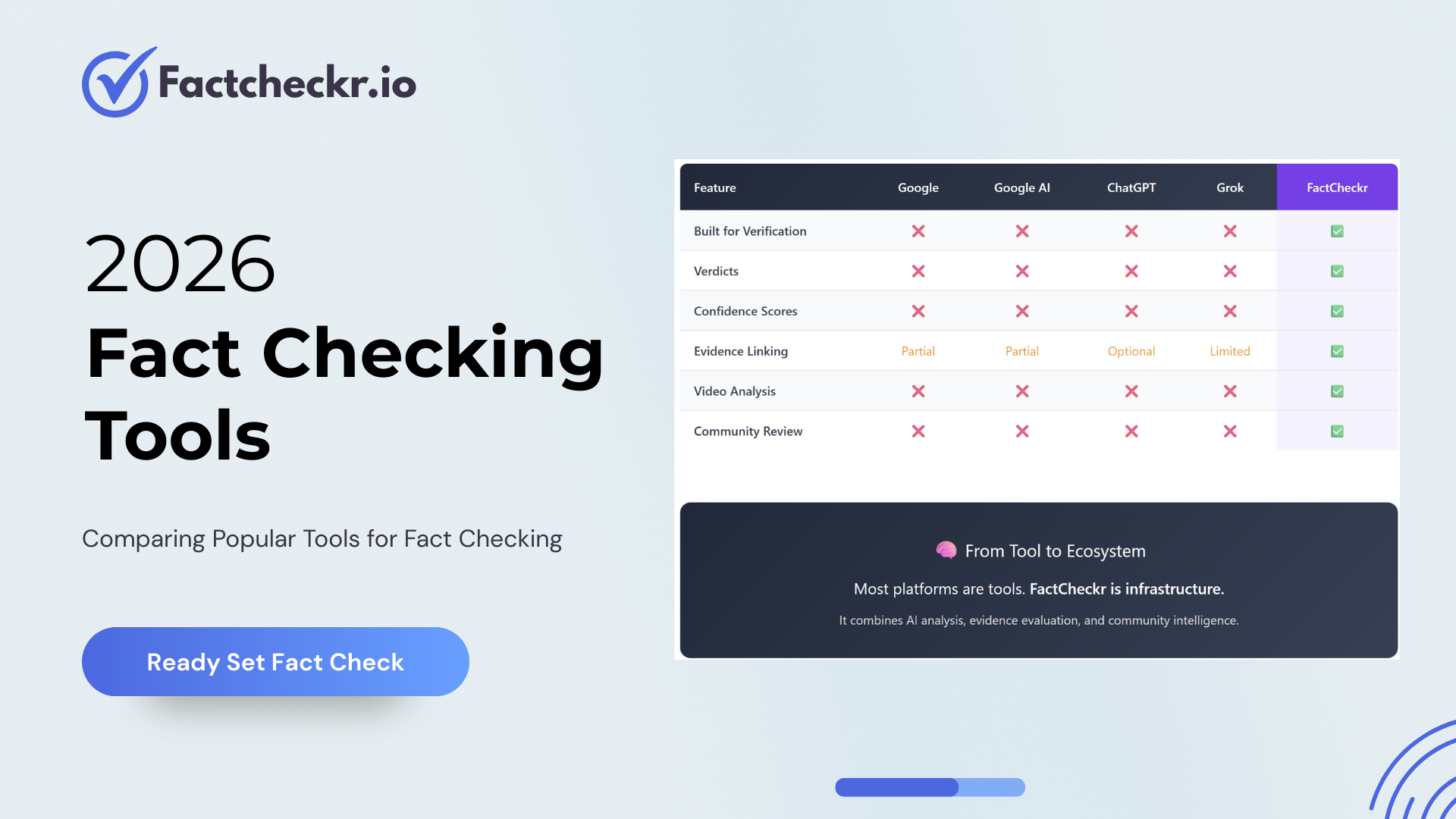
📊 Feature Comparison (Fact-Checking Focus)
| Feature | Google AI | ChatGPT | Grok | FactCheckr | |
|---|---|---|---|---|---|
| Built for Verification | ❌ | ❌ | ❌ | ❌ | ✅ |
| Verdicts | ❌ | ❌ | ❌ | ❌ | ✅ |
| Confidence Scores | ❌ | ❌ | ❌ | ❌ | ✅ |
| Evidence Linking | Partial | Partial | Optional | Limited | ✅ |
| Video Analysis | ❌ | ❌ | ❌ | ❌ | ✅ |
| Community Review | ❌ | ❌ | ❌ | ❌ | ✅ |
🧠 From Tool to Ecosystem
Most platforms are tools. FactCheckr is infrastructure.
It combines AI analysis, evidence evaluation, and community intelligence.
🚀 The Future of Fact-Checking
As AI-generated content grows, verification must scale with it.
Future trends include:
Deepfakes
Synthetic Media
Automated Misinfo
AI Propaganda
Purpose-built systems will become essential.
✅ Final Verdict
| Goal | Best Platform |
|---|---|
| Find sources | |
| Read summaries | Google AI |
| Understand topics | ChatGPT |
| Track trends | Grok |
| Verify truth | FactCheckr |
📌 Conclusion
Google, Google AI, ChatGPT, and Grok are powerful tools.
But none were designed primarily to answer:
"Is this claim true, and how confident are we?"
FactCheckr.io was.
By combining AI, evidence, and community intelligence, it provides a foundation for trustworthy verification in a complex information world.